Back in the olden days of AOL Instant Messenger, I was a journalism major who thought she was really clever with her away messages. Quotes from The Simpsons, or a cryptic “out for the night,” or a play on words.
At that time, I thought an away message like “allergeez” was a real banger. This was in college in Chicago, where I had developed seasonal allergies seemingly out of nowhere. I became a slave to Zyrtec and Flonase. Sinus infections were as routine as Friday morning hangovers.
Those allergies dissipated over time, but in the past few years in Ojai, they’ve come back in all their powerful pollen vengeance. I’m not opposed to the Zyrtecs and other antihistamines of the world when push comes to sneeze, but now that I’m older and somewhat wiser and more curious about the medicine in plants, I have a different dealer.
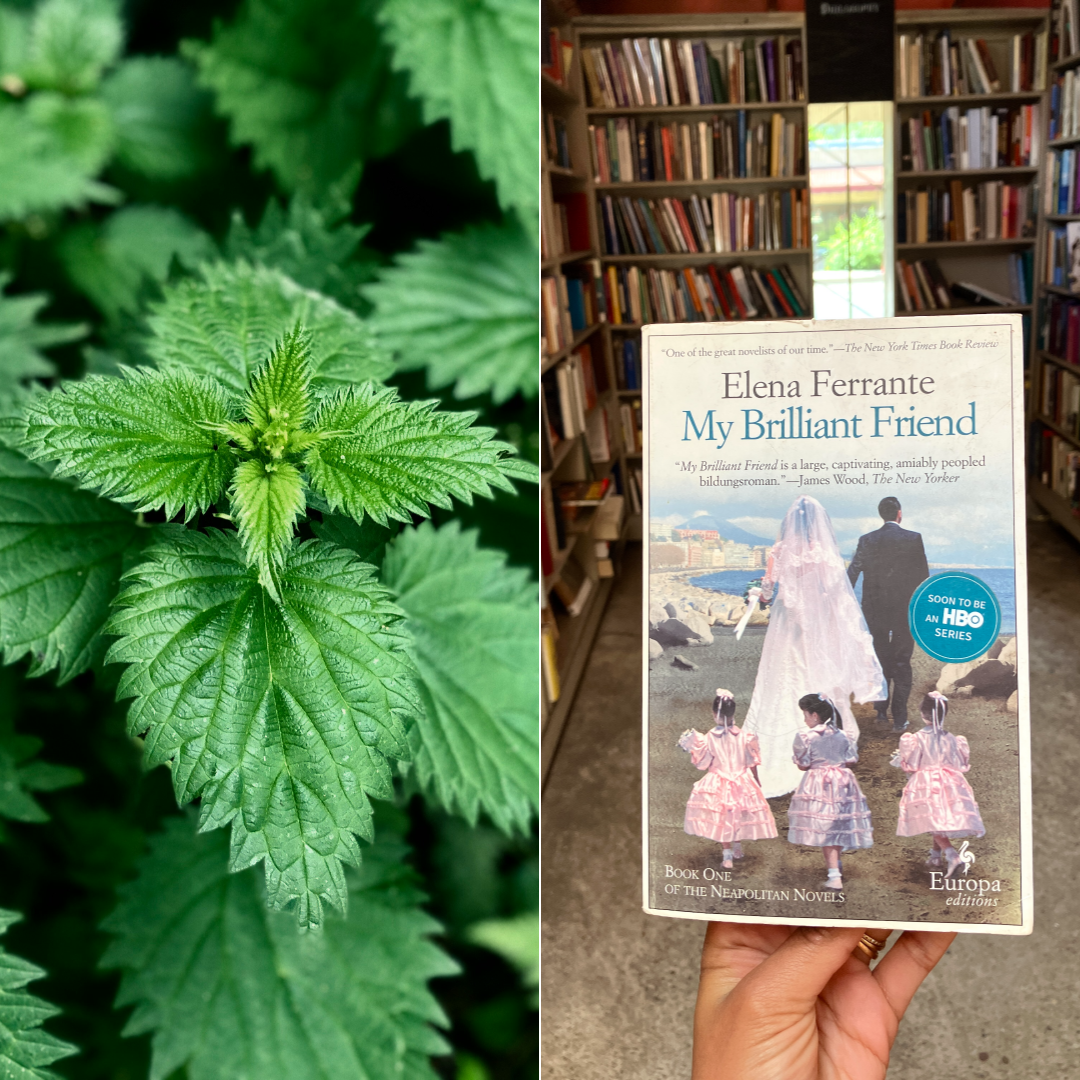
Nettles. Beyond allergy relief, many herbalists consider Urtica dioica a medicine chest in and of itself. “Echinacea might be the gateway plant that introduces many people to herbalism,” says herbalist Kat Maier, “but once through the herbal portal, it is nettle that becomes the herbalist’s most beloved remedy.”

Because nature knows what we need, just as seasonal allergies kick in, so does nettle leaf. Spring is the perfect time to harvest nettle leaves (wear gloves, more on that below) before the plant puts its energy into summer flowering. Avoid fall harvesting; those later-in-the-season leaves develop compounds that can irritate the kidneys. (But interestingly, nettle seeds are a kidney tonic. The roots are used for benign prostate hyperplasia.)
I mainly work with nettle leaves. They're a whole-body tonic with oodles of medicinal benefits. Here are a few:
Nettles are an antihistamine. Nettle eases allergies and hay fever by blocking Histamine-1 (H1) receptors. Some herbalists say to get this benefit, you’ll need to drink 1 quart of nettle tea every day for a month leading up to allergy season. That’s way too much tea for me—especially because nettle is a diuretic—so I do what I can, which is 12 ounces of nettle tea almost daily this time of the year. Or, take freeze-dried nettle capsules.
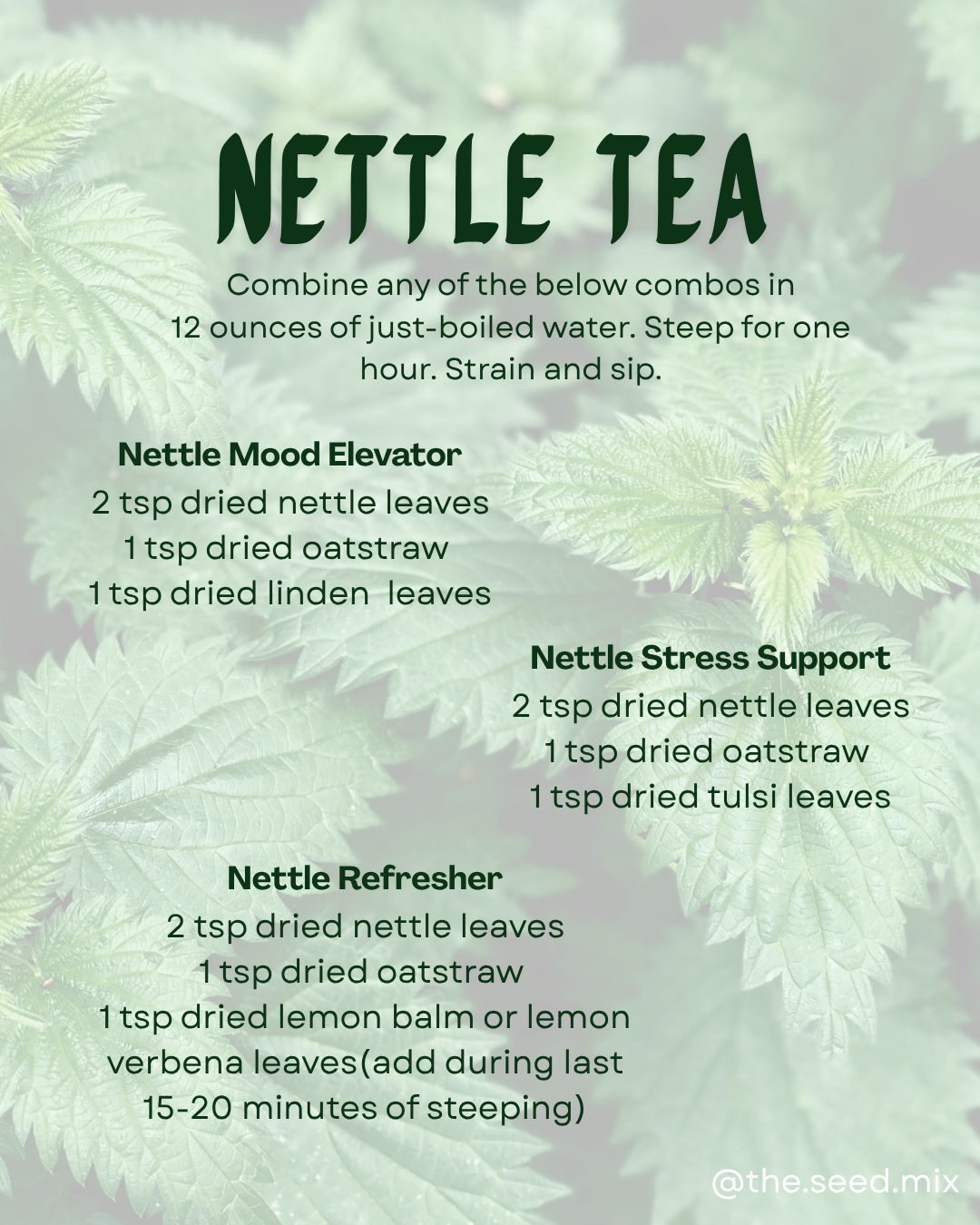
Nettles are packed with vitamins and minerals. Iron, calcium, magnesium, silica, potassium, Vitamin C, Vitamin K, chlorophyll—nettle’s got all that and more. It’s a great support for anemia, low hemoglobin, varicose veins, creaky joints and overall weakness/exhaustion.
Nettles have three times more protein than rice, barley and wheat. It also has a lot of amino acids, which makes it great for vegetarians and vegans.
Nettles strengthen weak hair. If you’re shedding strands, try a nettle rinse. Simmer a handful of nettle leaves in about 4 cups of water for 2 hours. Cool, strain, bottle. Apply it to hair post-shampoo and keep it on for about three minutes before rinsing out. Or comb fresh nettle juice through hair. The nettles bring circulation to the scalp and help strengthen hair overall. (I also love this oil cleanser with nettles to get the nutrients another way.)
Nettles are delicious. Nettle pesto. Nettle ravioli. Nettle spanokopita. Pickled nettles. Nettle in my this chickpea stew. In most cases, whenever a recipe calls for greens, try subbing in nettle. This is a regular in my kitchen:
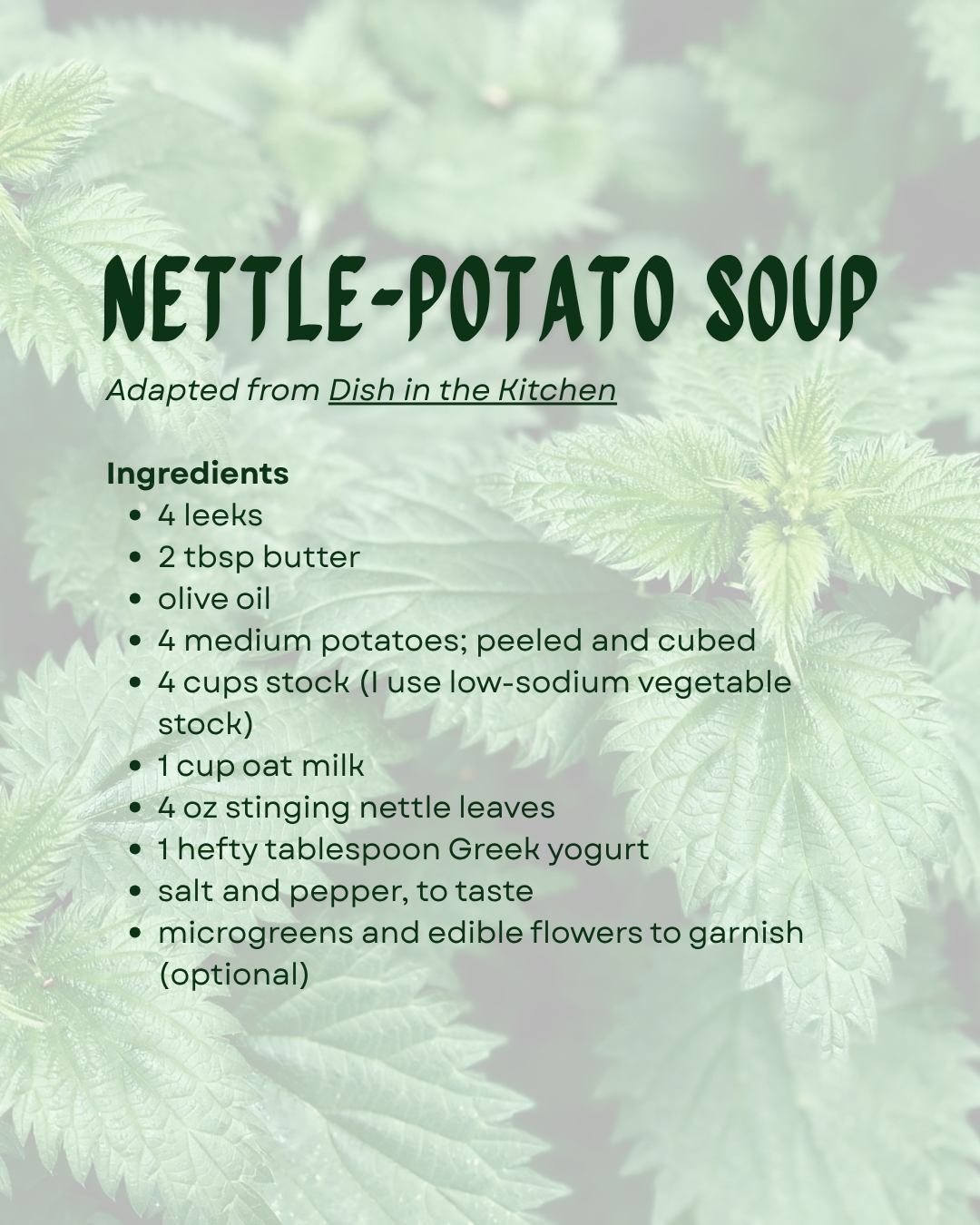
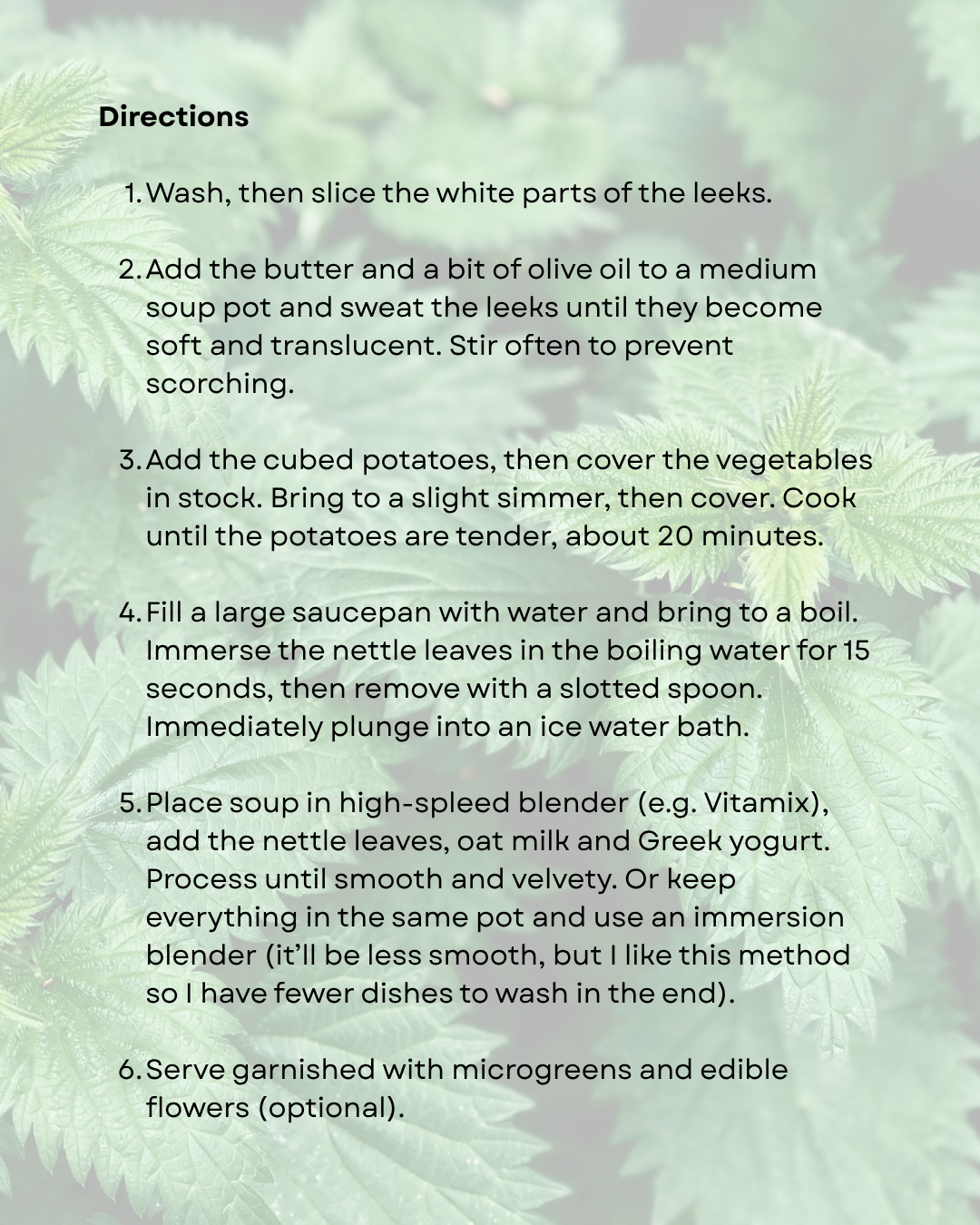
Herbalist Rachelle Robinett calls nettle a “pharmakon,” a paradoxical Greek word that can be loosely translated as something that’s both remedy and poison. Nettle is not a poison, but fresh stinging nettles leaves are lined with hypodermic-esque needles (called trichomes) that contain histamine and formic acid, the stuff that make ant and bee bites sting. For some people, a brush with nettle's fresh serrated leaves means a sting (it’s temporary, and doesn’t spread or persist the way poison oak or ivy does). Let’s call this part the “poison.” (Cooking or pulverizing the leaves in a food processor eliminates the sting.)
For others, contact with fresh nettles can feel like a buzzy stimulation, in a good way. That’s why they'll intentionally rub stinging nettle leaves on arthritic areas or on their wrists for carpal tunnel. It can bring much-needed circulation to the troubled areas. If you’re going to try this method, be extra cautious. I haven’t done it myself—my skin is so sensitive and I’m one of those people who feels it as a sting, not as stimulation. (That’s also why I haven’t planted nettles in my garden even though I love it so much as food and medicine. It’s a robust self-seeder who will pop up every and anywhere, and I really don't want to keep accidentally rubbing up on it.)
But I don’t have to rub up on stinging nettle to appreciate that dichotomy of healing and hurting. It’s certainly not the only plant with this split — foxglove is another, and even poison oak has medicinal benefits when used properly. And plants are certainly not the only beings who can do it either.
Many humans are really, really good at embodying both the cure and the kill, the light and the shadow. I’m not talking about the overt Jekyll and Hyde, but the more subtle duality. Someone who can prick and protect in one go.
Take Raffaela “Lina/Lila” Cerullo, the central character in the Neapolitan novels. The quartet of books by the pseudonymous author Elena Ferrante traces a lifelong friendship between two girls, from their rough, violent upbringing in a working-class neighborhood in Naples, Italy in the 1950s to them in their 60s today.
When the books were released in translation in the U.S. between 2011 and 2014, they generated “Ferrante fever,” an obsession with the characters, the “iconically ugly” covers, and most of all, the relationship between main characters Lila and Elena (Lenù). (Side note: The HBO series is the best page-to-screen adaptation I've ever watched. As I do for The White Lotus, I never skip the intro. I love the books and show so much that listening to that opening theme by Max Richter—who also composed Hamnet—makes me emotional.)
Lila and Lenù are best friends who are competitive, jealous and sometimes nasty to each other but also devoted to, admiring of and in love with each other as friends. Some readers think Lila and Lenù are one person, embodying the light and the shadow.
All of the books are told from Lenù’s perspective. And just listen to all the way she describes Lila:
- “Lila was malicious.”
- “Her quickness of mind was like a hiss, a dart, a lethal bite.”
- “She was… like a salted anchovy.”
- “She had a sharp tongue.”
- “She knew how to wound with words.”
Lenù is insecure, but she’s no saint either. She dabbles in schadenfreude. She constantly wants to match or beat where Lila is at (“...now that Lila was really engaged, officially engaged…it was more urgent than ever that I, too, should have an inevitable fiancé and so rebalance our relationship.”) So then how could Lila and Lenù possibly be best friends?
Maybe that's why Ferrante starts the story when Lila and Lenù are so young. When you’re little, friendships are primal, extreme. You hold hands, have sleepovers, become obsessed with each other. Kids also have fewer filters. They say what’s on their mind, no niceties needed. By starting the friendship there, Ferrante can dig into the full spectrum of feelings that often get sublimated as we get older, stupider and more reserved.
The book is also about power. Not just among the loan sharks and mafiosos of the neighborhood, but in the many ways women can use their minds and bodies to wield power. Lila has a beauty and magnetism that attracts multiple suitors, but it’s her cunning, sometimes diabolical brain that she puts to use. Her sharp tongue, salty disposition and feral personality are her power and also her protection so she doesn’t get chewed up and spit out by the violent neighborhood that raised her. (Those are all signs of her insecurity, too, but I digress.)
There’s folklore about nettle that embodies this idea about power, armor and protecting what we got, too. Indigenous author Walking Night Bear writes about how wild nettles used to look totally different. Not green, but shiny gold. People and animals were so enamored by a plant that was both beautiful and medicinal that they harvested, harvested, and over-harvested without gratitude. That's when, as the story goes, nettles suited up in their stinging armor. The medicine was still there, but now there was a boundary, a shield to protect the power within those leaves, seeds and roots.
REFERENCES
Bhusal KK, Magar SK, Thapa R, Lamsal A, Bhandari S, Maharjan R, Shrestha S, Shrestha J. Nutritional and pharmacological importance of stinging nettle (Urtica dioica L.): A review. Heliyon. 2022 Jun 22;8(6):e09717. doi: 10.1016/j.heliyon.2022.e09717. PMID: 35800714; PMCID: PMC9253158.
Cech, R., & Cech, S. (2016a). Making plant medicine. Herbal Reads.
Ferrante, E. (2012). My brilliant friend (A. Goldstein, Trans.). Europa Editions.
Holmes, P. (1989). The energetics of Western herbs: Volume 1: A materia medica integrating Western and Chinese herbal therapeutics (Vol. 1). Snow Lotus Press.
Jones, Lucy. A working herbal dispensary. Aeon Books, 30 May 2023.
Khuma Kumari Bhusal, Saraddha Khasu Magar, Ronika Thapa, Ashish Lamsal, Sagar Bhandari, Rashmi Maharjan, Sami Shrestha, Jiban Shrestha, Nutritional and pharmacological importance of stinging nettle (Urtica dioica L.): A review, Heliyon, Volume 8, Issue 6, 2022, e09717, ISSN 2405-8440, https://doi.org/10.1016/j.heliyon.2022.e09717.
Maier, K. (2022). Energetic herbalism. Chelsea Green Publishing Co.
Roschek B Jr, Fink RC, McMichael M, Alberte RS. Nettle extract (Urtica dioica) affects key receptors and enzymes associated with allergic rhinitis. Phytother Res. 2009 Jul;23(7):920-6. doi: 10.1002/ptr.2763. PMID: 19140159.
Walking Night Bear, & Padilla, S. (1987). Song of the seven herbs. Book Pub. Co.
Winston, David. Herbal therapeutics: Specific indications for herbs & herbal formulas. Herbal Therapeutics Research Library, 2013.
Wood, Matthew. The earthwise herbal, volume 1 : A complete guide to old world medicinal plants. Berkeley, Calif., North Atlantic Books, 2008.